


Our Story
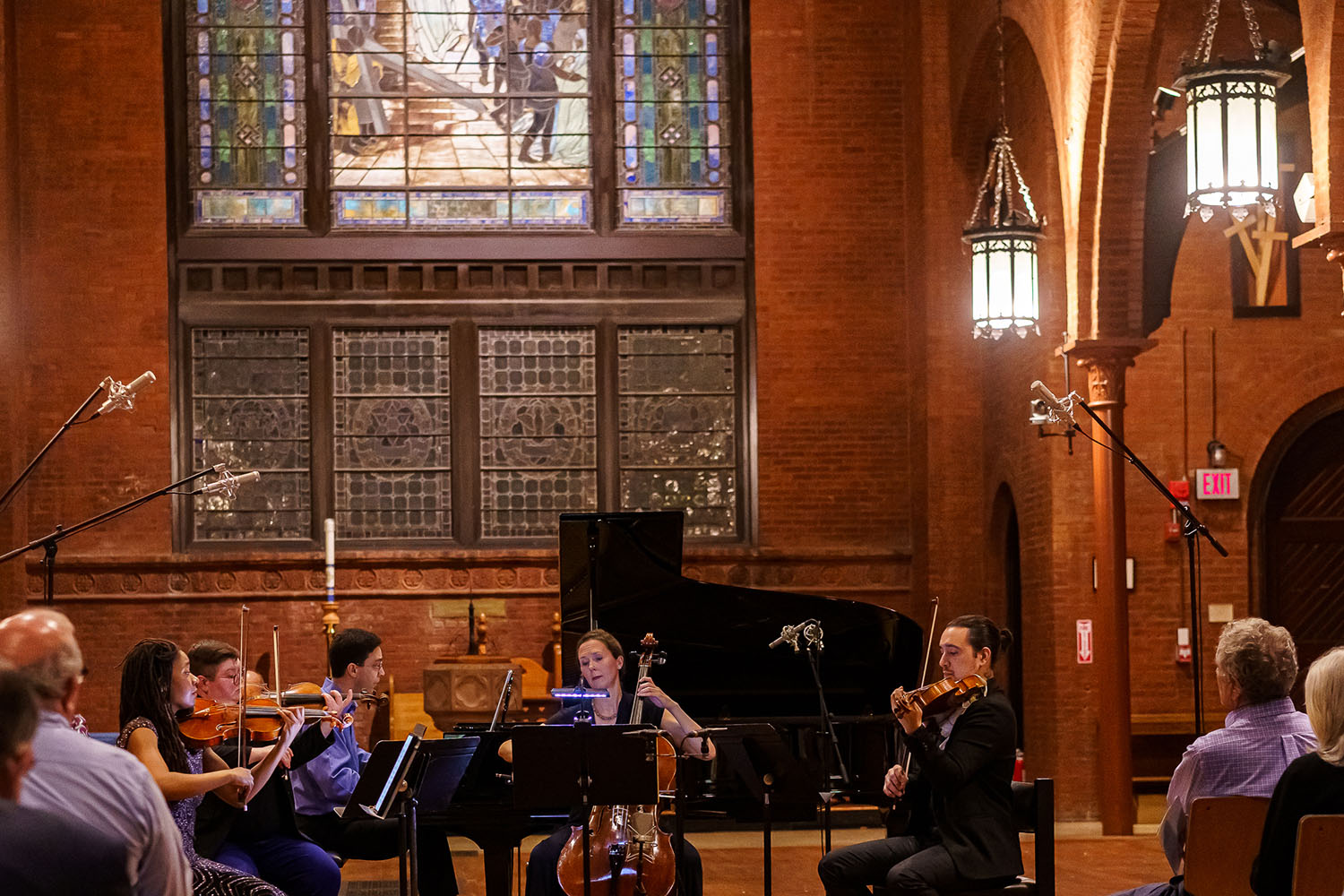
Founded in 2015 by pianist Efi Hackmey and cellist Carrie Bean Stute, Chiarina — a hybrid of chamber music series and self-presenting performer collective — brings distinctive chamber music performances and innovative programming to an intimate neighborhood setting in the historic residential sector of Capitol Hill in Washington, D.C.
Recognized in the Washington Post for putting on “some of the most compelling chamber music programs in town” and noted in the Washington Classical Review’s Critic’s Choice (2023-24) and its Top Ten Performances of 2022 and 2021, Chiarina is the recipient of grants from Chamber Music America, Mid Atlantic Arts, the DC Commission on the Arts and Humanities, and the Capitol Hill Community Foundation, including that organization’s inaugural Franzén Award for the Arts. Chiarina’s performances are regularly featured on Classical WETA’s Front Row Washington.
Chiarina has collaborated with the award-winning Attacca Quartet, Aizuri Quartet, and Imani Winds in mini-residencies that included public concerts and visits to neighborhood public schools. Chiarina’s guest artist roster features performers from such ensembles as the Orion String Quartet, Sphinx Virtuosi, Orpheus and St. Paul Chamber Orchestras, Chamber Music Society of Lincoln Center, New York Philharmonic, and National Symphony and Philadelphia Orchestras, and faculty members from such institutes as the Juilliard and Mannes Schools, Peabody and Bard Conservatories, and the University of Maryland.
Highlights of the 25-26 season include a collaboration with the Catalyst Quartet, to include visits to neighborhood schools, a commission and premiere by composer Jeffrey Mumford, a concert for families and children, an album launch celebrating Chiarina’s debut recording, a performance of Copland’s Appalachian Spring, a recital with clarinetist Ricardo Morales, a spotlight on DC composers, and more.
The inspiration for Chiarina’s namesake comes from Robert Schumann’s Carnaval, Op. 9, for piano. The name reminds us not only of Schumann’s imaginative spirit, but of his pianist-composer wife Clara, one of the most consequential musical figures in 19th-century Germany.